
Category: Strategy, Measurement & Performance
It is by now a commonplace of the change management literature that most organizational change efforts fail. The figure most frequently cited places the failure rate near seventy percent, and while the precise number has been contested, the underlying observation has proven durable: organizations commit substantial resources to change initiatives that do not produce lasting change. The question worth pursuing is not whether this is so, but why — and the answer, I want to suggest, exposes an assumption so deeply embedded in our thinking about change that it is rarely examined at all. That assumption is linearity.
The dominant models of organizational change are sequential in form. They conceive of change as a series of steps executed in order. Kotter (1996) offers perhaps the most influential of these frameworks, an eight-step model that has shaped a generation of practice precisely because it offers this reassuring linearity: establish urgency, build a guiding coalition, form a vision, communicate it, empower action, generate short-term wins, consolidate, and anchor the change in the culture. The promise embedded in such a model is that change will follow if the steps are completed in sequence. The difficulty is that organizations are not the kind of systems in which this promise can be kept.
Organizations are complex adaptive systems, and complex adaptive systems possess properties that defeat sequential planning. They are composed of many interacting agents whose behavior cannot be fully predicted; they exhibit emergence, in which system-level patterns arise from local interactions and cannot be reverse-engineered into a set of instructions; they contain feedback loops, so that the output of an intervention becomes the input to the next state in ways that compound or dampen unpredictably; and they are sensitive to initial conditions, such that the same intervention applied in two superficially similar organizations may produce markedly different results. A linear change model fails in a system of this kind not because its individual steps are wrong but because its shape is wrong. The conditions that justified a vision have shifted by the time a leadership team has communicated it; the coalition assembled early has fractured under later pressure; the short-term wins prove fragile because the system has adapted around them rather than integrating them. Linear models interpret these outcomes as failures of execution — the organization did not follow the steps correctly. I would argue they are failures of design. The model assumed a stability that the system does not possess.
This connects to a distinction that I find indispensable, drawn from the work of Heifetz (1994): the distinction between technical problems and adaptive challenges. A technical problem can be solved through existing knowledge and the application of authority. An adaptive challenge requires the people within the system to change their values, their habits, and their ways of working, and such change cannot be delivered to people in the manner of a technical fix. The members of the system must do the adaptive work themselves, and that work is iterative, emotional, and recursive rather than sequential. A change model that is linear in form is therefore not merely imprecise when applied to adaptive challenges; it is categorically mismatched to the nature of the work.
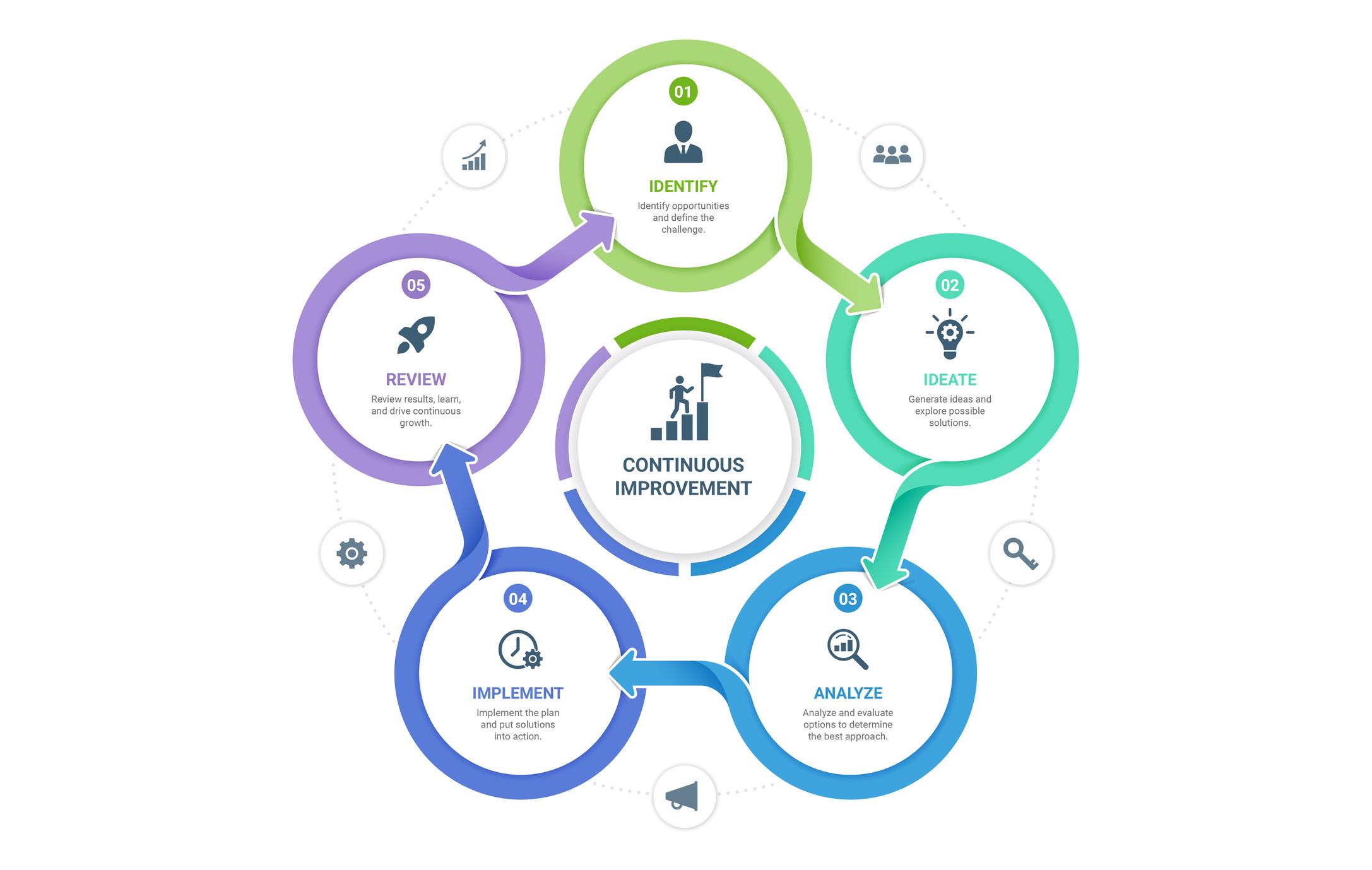
The Adaptive Balance Method™ proceeds from the premise that change must be treated as a cycle rather than a checklist. This is not a cosmetic reframing. A cycle possesses properties that a sequence does not: it assumes return, it incorporates feedback, and it treats each passage through its phases as informing the next. A linear model concludes — the change anchored, victory declared — whereas a cyclical model loops, because the work in a complex adaptive system is never finished but only re-balanced at a higher level of capacity. The cycle moves through five phases, and the order in which they are placed is itself a substantive claim.
The first phase is to stabilize. A system must be steady enough to bear the disturbance that change introduces before it can change at all. Stabilization is the work of establishing psychological and structural footing — of reducing the acute anxiety that renders people defensive, and of clarifying what will not change so that what must change becomes tolerable. Leaders routinely omit this phase, mistaking urgency for readiness, and they pay for the omission later, when the system, having never found its footing, collapses under the weight of the intervention. The second phase is to narrate. Human systems run on meaning, and a change that is not narrated — not rendered intelligible in terms the members can metabolize — will be narrated anyway, by rumor and by fear. Narration is the disciplined construction of a shared and honest account of where the organization stands, how it arrived there, and what the change is for. It is not spin; it is the cognitive scaffolding that allows people to locate themselves within the change rather than experiencing it as something done to them.
The third phase is to recognize. Accurate perception must come before repair. Recognition is the diagnostic phase, in which the system is seen clearly, including the parts that are uncomfortable to see, and in which symptoms are distinguished from sources. A great deal of what passes for change management is action undertaken before recognition is complete, which is why it so reliably treats symptoms while the source persists. The fourth phase, and only the fourth, is to repair — to rebuild the structures, relationships, and agreements that have fallen out of coherence. Repair is placed fourth deliberately, because intervention that precedes stabilization, narration, and recognition is intervention aimed at the wrong target. Repair undertaken in its proper sequence is targeted, proportionate, and far more likely to hold. The fifth phase is to rebalance. The cycle does not end so much as it resettles. Rebalancing integrates the change into the ongoing life of the system and reads the new conditions the change has produced — conditions that become, in turn, the starting point for the next passage through the cycle. Linearity cannot accommodate this phase, because it treats the conclusion of one change as the beginning of the next, which is how adaptive systems in fact behave.
The claim embedded in this method is modest in form and considerable in consequence: the likelihood that a change endures improves dramatically when the shape of the change process is matched to the shape of the system being changed. Linear models fail in non-linear environments not through poor execution but through a mismatch of form. A cyclical method succeeds not because it is more sophisticated but because it is more honest about what an organization is — a living system that must be returned to balance again and again, each cycle leaving it more capable than the last. Resilience is the practice; balance is the goal; and the cycle is the form the practice takes.